数学家传记
洛伦佐·马斯凯罗尼是一位几何学家,他于1797年证明所有欧几里得作图都可以仅用圆规完成,因此不需要直尺。
洛伦佐·马斯凯罗尼的父母是Maria Ciribelli和Paolo Mascheroni dell'Olmo,后者是一位富有的地主。马斯凯罗尼受教育的目标是成为神父,他在17岁时被授予圣职。起初他教修辞学,然后从1778年起,他在贝加莫的神学院教授物理学和数学。
1786年,马斯凯罗尼成为帕维亚大学的代数学和几何学教授,主要凭借他一年前出版的关于静力学的优秀著作Nuove ricerche su l'equilibrio delle volte。后来,在1789年,他成为该大学的校长,担任该职务四年。在1788年至1791年间,他是Accademia degli Affidati的负责人。
在Adnotationes ad calculum integrale Euleri Ⓣ(关于莱昂哈德·欧拉积分学的笔记)(1790年)中,马斯凯罗尼将莱昂哈德·欧拉常数计算到了32位小数。事实上只有前19位是正确的,但其余位数在1809年由Johann von Soldner更正。尽管计算中有错误,马斯凯罗尼的工作显示了对莱昂哈德·欧拉微积分的深刻理解。
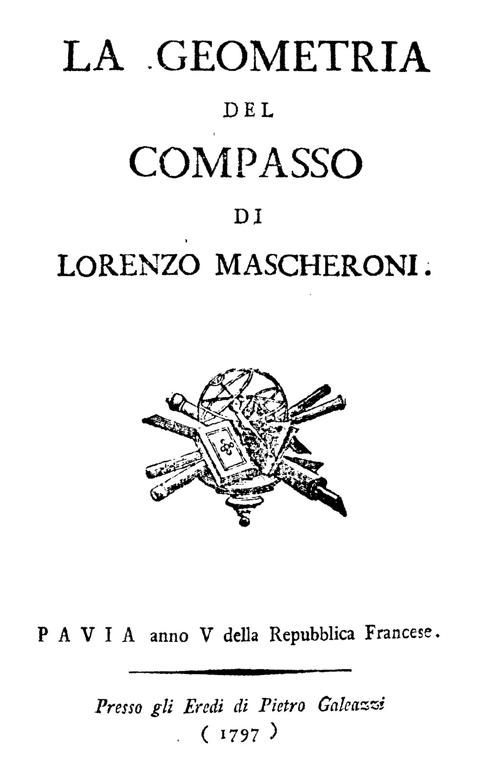
马斯凯罗尼也以诗人闻名,他曾以诗歌形式将他的其中一本书Geometria del compassoⓉ(《圆规几何》,1797年于帕维亚出版)献给拿破仑·波拿巴。在这部著作中,马斯凯罗尼证明了所有欧几里得作图都可以仅用圆规完成,因此不需要直尺。事实上,这一点早在1672年就已被一位鲜为人知的丹麦数学家乔治·莫尔证明(马斯凯罗尼对此并不知晓)。在Geometria del compassoⓉ(《圆规几何》)的序言中,马斯凯罗尼解释了他如何着手处理这个问题[1]:-
他最初是出于对初等几何作出贡献的愿望。他想到,直尺和圆规或许可以像水可以分解为两种气体那样被分离开来;但他受到疑虑和恐惧的困扰,这些常常伴随着研究而来。后来他偶然重读了一篇关于格雷厄姆和伯德如何划分他们的大型天文象限仪的文章,他意识到那划分是仅用圆规完成的,尽管确实是通过试错法。这鼓励了他,他继续自己的工作,心中有两个目标:为仅用圆规的作图问题给出理论解答,并提供可能有助于制造精密仪器的实用作图方法。
文章[3]给出了马斯凯罗尼书中内容的大致情况。在其中他展示了如何仅用圆规来平分给定的圆弧、加减给定的线段、求三条给定线段的第四比例项、求两条给定直线的交点,以及求给定直线与给定圆的交点。从这些问题的解答出发,他能够在理论上证明,任何可以用直尺和圆规完成的作图都可以仅用圆规完成。
由于马斯凯罗尼的杰出贡献,他获得了许多荣誉,例如当选为帕多瓦科学院、曼图亚皇家科学院以及意大利科学学会的成员。
1797年,马斯凯罗尼被任命为米兰执政立法议会的代表。法国人一直在致力于引入公制 weights and measures,1795年4月7日,国民公会通过了一项法律,引入公制,并让阿德里安-马里·勒让德负责向新制度的过渡。马斯凯罗尼被派往巴黎研究新制度,并向米兰的执政机构报告。他于1798年发表了他的报告,但1799年第二次反法同盟战争爆发,当时拿破仑·波拿巴正在埃及,法国政府陷入危机。奥地利趁机拉拢俄罗斯作为盟友,然后在包括意大利北部在内的多条战线上进攻法国。由于战争和1799年奥地利占领该城,马斯凯罗尼无法返回米兰。他留在巴黎,次年因感冒后并发症引起的短暂疾病在那里去世。
人们不禁要问,马斯凯罗尼是否值得因证明了一个乔治·莫尔在125年前就已证明的结果而获得赞誉。我们必须问的第一个问题是,马斯凯罗尼是否可能知道乔治·莫尔的结果。如果检查这两个证明,就会发现它们处理问题的方式非常不同。人们确实会相信马斯凯罗尼不可能知道乔治·莫尔的证明,但他仍然有可能听说过这个结果早些时候已被证明。这似乎不太可能,即使他看到了这个结果的陈述,也几乎不会减损他的成就。在我看来[EFR],马斯凯罗尼和乔治·莫尔都值得同等的赞誉。
Lorenzo Mascheroni's parents were Maria Ciribelli and Paolo Mascheroni dell'Olmo who was a wealthy landowner. Mascheroni was educated with the aim of becoming a priest and he was ordained at the age of 17. At first he taught rhetoric then, from 1778, he taught physics and mathematics at the seminary at Bergamo.
In 1786 Mascheroni became professor of algebra and geometry at the University of Pavia, mainly on the strength of his excellent work on statics Nuove ricerche su l'equilibrio delle volte which he had published one year earlier. Later, in 1789, he became rector of the university, holding the appointment for four years. During the years 1788 to 1791 he was head of the Accademia degli Affidati.
In Adnotationes ad calculum integrale Euleri Ⓣ (1790) Mascheroni calculated Euler's constant to 32 decimal places. In fact only the first 19 places were correct but the remaining places were corrected by Johann von Soldner in 1809. Despite the error in the calculation, Mascheroni's work shows a deep understanding of Euler's calculus.
Mascheroni is also known as a poet and he dedicated one of his books Geometria del compasso Ⓣ (published in Pavia in 1797) to Napoleon Bonaparte in verse. In this work Mascheroni proved that all Euclidean constructions can be made with compasses alone, so a straight edge in not needed. In fact this had been (unknown to Mascheroni) proved in 1672 by a little known Danish mathematician Georg Mohr. In the preface to Geometria del compasso Ⓣ Mascheroni explains how he approached the problem [1]:-
He was moved initially by a desire to make a contribution to elementary geometry. It occurred to him that ruler and compass could perhaps be separated, as water can into two gases; but he was assailed by doubts and fears often attendant upon research. He then chanced to reread an article on the way Graham and Bird had divided their great astronomical quadrant, and he realised that the division had been made by compass alone, although, to be sure, by trial and error. This encouraged him and he continued his work with two purposes in mind: to give a theoretical solution to the problem of constructions with compasses alone and to offer practical constructions that might be of help in making precision instruments.
See THIS LINK.
The article [3] gives an idea of the content of Mascheroni's book. In it he shows how, with compasses alone, to bisect a given circular arc, to add and subtract given segments, to find a fourth proportional to three given segments, to find the point of intersection of two given lines, and to find the points in which a given line meets a given circle. From the solution to these problems he is able to prove theoretically that any construction which can be made using a ruler and compasses can be made with compasses alone.
For his excellent contributions Mascheroni received a number of honours such as election to the Academy of Padua, the Royal Academy of Mantua and to the Società Italiana delle Scienze.
Mascheroni was appointed as a deputy in the governing legislative assembly in Milan in 1797. The French had been working on the introduction of the metric system of weights and measures and on 7 April 1795 the National Convention had passed a law introducing the metric system putting Legendre in charge of the transition to the new system. Mascheroni was sent to Paris to study the new system and to report to the governing body in Milan. He published his report in 1798 but the War of the Second Coalition began in 1799 while Napoleon Bonaparte was in Egypt and the French government was in crisis. Austria took the opportunity to secure Russia as an ally and then attack the French on several fronts including the north of Italy. Mascheroni was unable to return to Milan due to the war and the Austrian occupation of the city in 1799. He remained in Paris where he died in the following year after a brief illness resulting from complications after catching a cold.
One is left with asking whether Mascheroni deserves the credit for proving a result which Mohr proved 125 years earlier. The first question we must ask is whether Mascheroni might have known of Mohr's result. If one examines the two proofs it is seen that they approach the problem in very different ways. One is certainly led to believe that Mascheroni could not have known Mohr's proof but it is still possible that he had heard that the result had been proved earlier. This does not seem particularly likely and even if he had seen the result stated it detracts little from his achievement. It is clear to me [EFR] that both Mascheroni and Mohr deserve equal credit.
正文里的方括号编号指向这里,悬停即可直接看到条目。书目保留原文——译了书名反而查不到文献。
原站列出的延伸阅读与外部数据库,照原样保留,目标多为英文页面。
关于洛伦佐·马斯凯罗尼的其它页面:
原站的交叉引用。指向本站已镜像专题的留在站内,其余仍指回原站。